
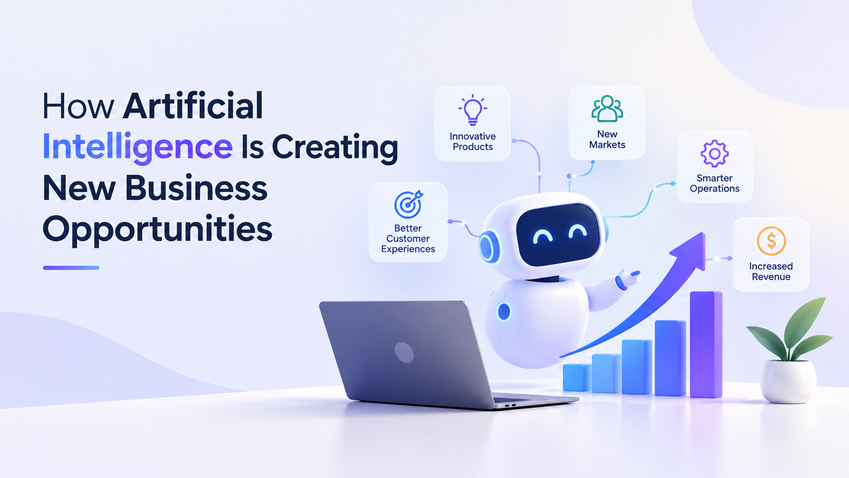
A few years ago, building a product, supporting customers, or keeping up with rivals took a large team, expensive software, and a lot of manual effort. Now the right tools can do much of that work faster. As a result, AI business opportunities are turning up in nearly every industry, and both established companies and first-time founders are finding fresh ways to solve problems and earn money.
It goes well beyond automating dull tasks. Businesses use artificial intelligence to notice customer needs no one has addressed, make sharper decisions, personalize what they offer, and deliver things that used to be too hard or too costly. Small businesses gain the most here, because tools once reserved for big enterprises are now within their reach.
Still, knowing where the opportunities lie is only the first step. The real payoff comes from choosing a practical business problem and pairing it with the right technology.
1. Personalized Customer Experiences Open Up New Revenue Opportunities
Customers now expect products, recommendations, and service that match their own tastes. AI helps businesses deliver on that by studying behavior, past purchases, feedback, and conversations.
A retailer can recommend items a shopper is likely to want. A financial services provider can change how it speaks to each client. An online store can offer support that remembers earlier inquiries. Every interaction feels more relevant, and the company gets a much clearer view of what its customers need.
AI can also spot customers who are drifting away, which gives a team the chance to reach out with help or a better offer before they leave.
For entrepreneurs, this points to personalized shopping platforms, AI-powered customer support tools, recommendation engines, and customer analytics services. If you understand a particular audience well, personalization can be the product itself rather than a feature bolted on.
2. AI Automation Puts Specialized Services Within Reach
A lot of working time is spent on repetitive tasks: data entry, scheduling appointments, document processing, invoice management, and constant questioning. AI-driven automation in business relieves people from a considerable part of these tasks, letting them spend their time on more complex activities requiring decision-making and communication.
The automated system is able to prioritize customers’ inquiries, extract information from invoices, compose responses, and pass complex cases to competent people. Human involvement is required, especially in legal, financial, or customer-related issues.
That creates space for businesses that build automation for a specific industry. Some ideas:
- Appointment and inquiry management for clinics
- Document processing for accounting firms
- Customer service assistants for online retailers
- Inventory forecasting tools for distributors
- Workflow automation for recruitment agencies
You could charge a monthly subscription, a one-time implementation fee, or a usage-based rate. Companies that stick to one industry often come out ahead, since they already know its workflows and compliance rules.
3. AI for Small Businesses Is Leveling the Field
Only some time back, analytics and automation were something that needed heavy investments. Cloud AI systems have changed this situation for good. Now small firms can enjoy the benefits of these technologies without having to develop machine learning systems themselves.
Small firms can make use of the power of AI for purposes such as marketing, sales, customer service, budgeting, and content analysis. For instance, a local store may analyze their seasonal sales trends to optimize its inventory. A consulting firm may take notes at meetings and track recurring issues.
According to a McKinsey report, generative AI adds trillions of dollars in value to the world economy every year. Small businesses don’t have to stop at using existing tools. They can build services on top of them, such as AI-assisted bookkeeping, automated social media reporting, niche customer support, or smart scheduling.
The easiest starting point is a task that eats up plenty of time but follows a fairly predictable pattern. Once it’s automated, a small team can take on more customers without taking on more work.
4. Industry-Specific AI Solutions Can Unlock Untapped Markets
Artificial intelligence(AI) delivers the most when it tackles a problem that belongs to one particular industry. General-purpose tools are handy, but most businesses need something that understands their data, their workflows, and how they actually operate.
Here’s where that could play out:
- Healthcare: Administrative services, appointments, and assistance with patients’ medical records
- Manufacturing: Quality checking, predictive maintenance, and manufacturing planning
- Agriculture: Monitoring crops, making irrigation suggestions, and forecasting crop yield
- Education: Learning materials, automated grading, and assessment of student performance
- Logistics: Forecasting demand, route optimization, and monitoring shipments
- Real estate: Property data analysis, lead qualification, and customer communication
These business applications of artificial intelligence leave plenty of room for specialized software companies, consultants, and startups.
You don’t need to invent a new AI model to get going. A practical product built on existing models, reliable industry data, and a simple interface can be enough to meet a real market need.
That said, industry-specific tools must take data privacy, regulations, and the cost of wrong answers seriously. In sensitive settings, a person should stay involved in the process.
5. AI-Powered Business Models Are Changing How Companies Make Money
AI-powered business innovation is also shifting how companies package and price what they sell. Instead of depending only on one-time software purchases or hourly billing, businesses can offer recurring, usage-based, or result-based plans.
A few AI-powered business models are gaining ground:
- AI-as-a-Service: Availability of unique AI features by subscription or API
- Vertical AI software: Tools built for one industry or professional role
- AI consulting: Helping organizations find the right use cases and put AI systems in place
- Intelligent analytics: Insights drawn from customer, operational, or market data
- AI-enhanced services: Professional expertise combined with AI-assisted delivery for faster, more consistent results
A marketing analytics company, for example, could run a subscription platform that picks out campaign performance patterns and generates reports. A software provider might charge based on how many documents its system processes.
Before settling on a model, entrepreneurs should ask what customers will actually pay, what it costs to deliver the service, what the infrastructure will run, and how much human review will still be needed. Technology alone isn’t a business strategy. Steady revenue comes from solving a problem that customers care about enough to pay for.
6. Emerging AI Technologies Are Opening New Markets
New capabilities keep widening what businesses can build. These AI trends in business are worth watching as companies decide where to invest next.
- AI agents can handle tasks with several steps by using tools, looking up information, and following set instructions. Businesses might use them for research, workflow coordination, or internal support, as long as the right permissions and oversight are in place.
- Multimodal AI works with text, images, audio, and video together. That opens possibilities in product inspection, accessibility tools, interactive learning, and media analysis.
- Predictive AI uses past and current data to estimate what’s likely to happen next. It’s useful for inventory planning, equipment maintenance, demand forecasting, and keeping customers from leaving.
- Industry-specific language models can be tuned to specialized terminology and business documents. That helps organizations build internal assistants and knowledge tools that fit their work.
These emerging AI technologies hold real promise, but being new isn’t a reason to adopt something. Every investment should come with a clear use case, a way to measure success, and an honest view of what the technology can’t do.
7. Turning AI Opportunities Into Practical Business Strategies
AI technologies combined with entrepreneurship thrive best when the technical feasibility aligns with the customer needs. Should you wish to capitalize on these opportunities, a straightforward process will do the job.
- Define the problem that needs addressing. Speak to the customers and employees about the bottlenecks, inefficiencies, high expenses, and other obstacles. Make sure that the problem actually exists before deciding on which technology to leverage.
- Develop a pilot project first. Identify one process and implement an artificial intelligence solution on a limited scale. Compare the results with the existing process using such metrics as the time required for completion, errors, customer satisfaction levels, and cost per unit of action.
- Ensure data protection measures. Evaluate access to information, storage locations of the data, and sharing of personal data with third-party applications. Specify the policies related to approvals, access levels, and human intervention when necessary.
- Evaluate business performance. The decisions driven by AI algorithms must be based on evidence, rather than hunches. Measure the changes in terms of productivity, revenue increase, operational cost reduction, or better customer experience.
Organizations that need specialized technical help can look into AI integration services to connect AI capabilities with their existing applications, databases, and business processes.
Building a Business Around AI’s Next Wave
AI business opportunities are showing up in customer experience, automation, industry-specific software, analytics, and entirely new service models. The best ones usually begin with a familiar problem that current solutions haven’t handled well.
Companies do not have to adopt every latest technology simultaneously. It is about understanding your customers, picking the applications that are appropriate for them, securing your data, and measuring the outcome of every investment you make.
The future of all startups and existing companies comes down to the same task: choose one valuable problem to solve and measure the outcome of your efforts. This is how you move beyond an exciting technology and into a profitable business through the use of artificial intelligence.