

Every prosperous software venture doesn’t always have to become the equivalent of Salesforce or Shopify. Occasionally, much smaller issues can grow into successful business opportunities.
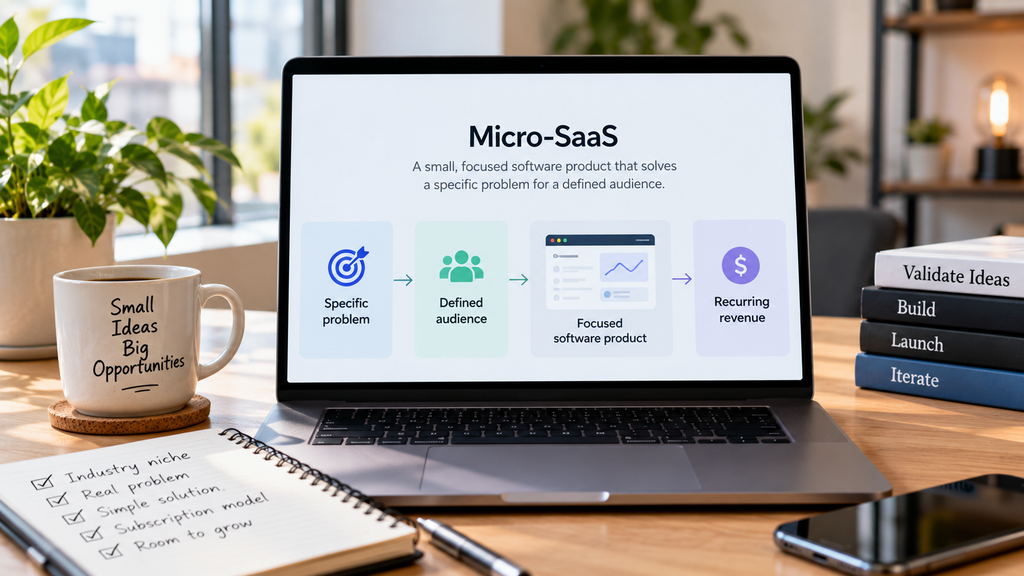
Micro-SaaS is based on this idea. It refers to a product that is focused solely on solving a certain problem for a particular group of users. Such solutions do not require entrepreneurs to create big platforms filled with a variety of functions—instead, programmers have to develop lightweight solutions that successfully deal with one particular hassle that people experience.
For people starting a business, freelancers, developers, and small teams, the fact that the focus has shifted from finding breakthrough ideas to recognizing problems that occur so often that people are ready to pay for being relieved from them is quite crucial.
What Is a Micro-SaaS Business?
Micro-SaaS is defined as a software-as-a-service firm that targets a specific case or segment. Micro-SaaS business products are run by an individual founder or a team. The revenues of Micro-SaaS come from subscriptions or recurring payments.
In contrast to SaaS software that tries to cover every aspect of a business, Micro-SaaS software focuses on one task.
For instance, instead of doing the whole HR management platform, some entrepreneur creates just a tool that reminds managers about reviewing their subordinates who are in probation. Another solution addresses the situation of an eCommerce platform.
The limited focus is advantageous as the development becomes simpler, customer requests become easier to fulfill, and product positioning gets clearer. If additional technical expertise is needed, a bespoke software development company can help build the product around that specific use case.
Begin with Problems Instead of Product Ideas
A frequent error is to start with a technology and look for something to do with it. A better way to start is to look for recurring problems. People should look at their own processes, speak to professional people working in specific industries, be active in online communities, read product reviews, or study some existing software. Phrases like “I have to do this manually every week” or “This product is great, but I only need one feature” can help find opportunities.
A good Micro SaaS problem usually has a number of key characteristics. It will have the following properties: it is a recurring problem that affects a well-known group of users, is time-consuming and has financial consequences of some sort, and needs an uncomfortable solution at that moment.
Spreadsheets may be a significant indicator. If you are making serious spreadsheets because of the lack of certain software functions, it can probably be a good solution for the future product.
Micro-SaaS Business Ideas to Consider
There are plenty of potential ideas for niches. The key is to define them in terms of a particular client and problem.
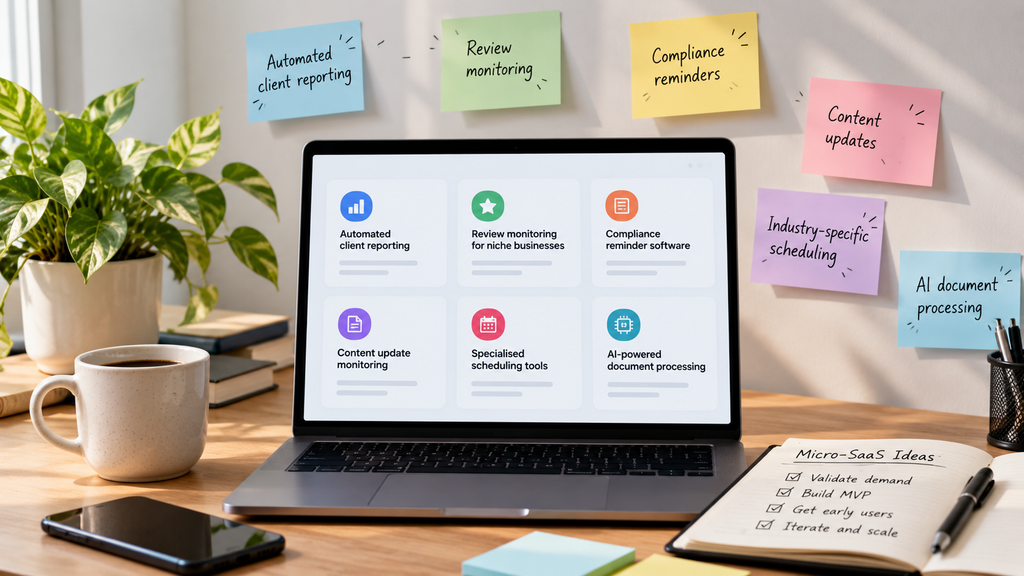
Automated client reporting
Marketing agencies, consultants, and freelancers typically bring together data from various channels prior to sending the report. Micro-SaaS could help retrieve selected KPIs and create the branded report with proper distribution.
Review monitoring for narrow niche businesses
Instead of building another general-purpose reputation management system, a startup owner might focus on dentists, restaurant businesses, and property managers, thus providing them with review centralization, notifications, alerts, and response procedures.
Monitoring content updates
Companies with large websites need to be notified if the articles, product information, pricing pages, or documentation is out of date.
Industry-specific scheduling tools
A standard calendar is not suitable in some specialized workflows. Tutors, photographers, mobile service companies, security service providers, and equipment rentals may require specific options for scheduling.
AI-based document processing
Micro-SaaS uses AI to classify documents, extract some fields, summarize repetitive reports, and convert unstructured data into structured data.
Validate Before Building
An application can take months of programming if the concept is not tested at the very beginning.
In the form of direct communication with prospective clients, founders can explore how they are working around the issue. It is not enough to find out whether the audience finds the idea appealing. What is essential is to understand if it is worth changing something or paying for its implementation.
The viability of a startup can be tested through a landing page with an option for early sign-ups. A clickable prototype can show how the process works without the need of programming the backend. Sometimes founders can provide part of the service manually in the beginning.
Price testing should also start at the initial stage. If ten people state that they like the idea of a product, it does not mean anything until one of them embodies his or her desire to pay for it.
Build the Smallest Product That Solves the Problem
When the demand has been confirmed, creating a minimum viable product must be the next step. For example, if one wants to develop a compliance tracker for small contractors, the first MVP version could include company profiles, certificate information, expiration dates, email notifications, and basic dashboards. Other features such as advanced analytics, integrations, mobile applications, and advanced access rights can come later based on user needs.
Narrowing down the MVP benefits both in terms of lowering the costs of development and reducing the amount of feedback for analysis.
However, there are also technical aspects to be taken into account. Founders need to think about the hosting solutions first, taking into account security, billing, integration, scalability, and system maintenance solutions. In case the entrepreneur does not have an engineer on the team, the best solution is to either use one of the tools with no-code capabilities for validation of the idea or contact a SaaS development company to create the commercial product out of the idea.
Small Software Can Still Become a Serious Business
Micro-SaaS is changing the question businesses should be asking. Rather than thinking about “What large software company can I develop?”, they should instead think about “What trivial issue is someone spending his/her time or money to solve?”. This alternative question creates a number of new possibilities.
For instance, it may seem trivial that a spreadsheet takes about two hours to be updated, that reports have to be written manually every Friday, or that there is always a concern about some certification deadlines. However, when one looks on a wider scale, it becomes clear that, once the same problem is shared by hundreds or thousands of people, there is now a basis for a successful business that can be created out of an insignificant issue. In addition, Micro-SaaS does not necessarily mean something exceptionally innovative.