

AI agents are becoming increasingly available to small enterprises. What previously necessitated a large engineering crew can now be constructed using existing CRM systems, help desks, accounting software, calendars, eCommerce platforms, and databases.
However, this does not imply that every repetitive task needs an AI agent.
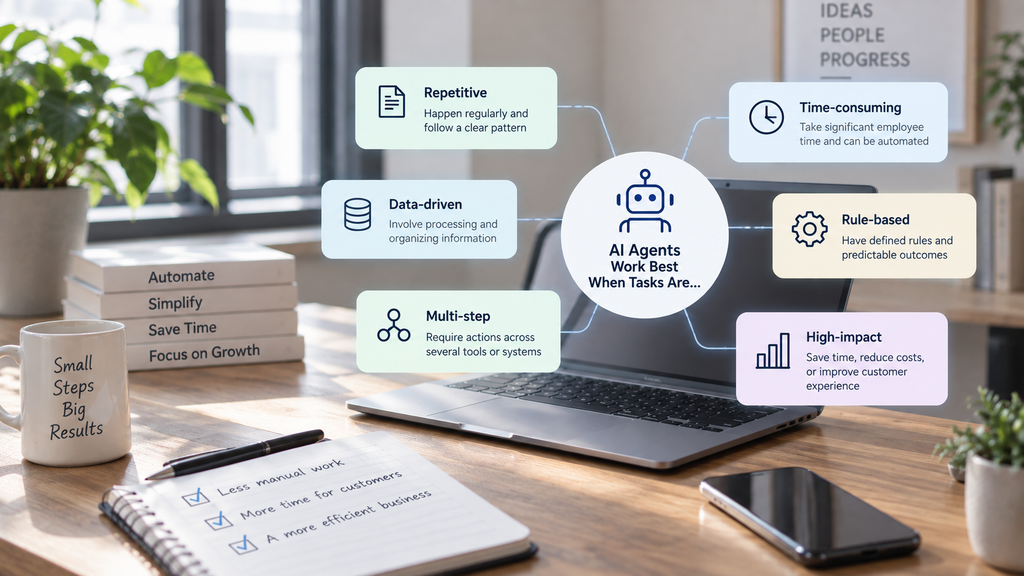
When it comes to small companies, the main point to take into consideration is which processes require so much time, happen frequently, and follow predictable patterns to be worth automating.
Examples of processes that can be automated include administrative processes, customer relations, sales, reporting, and managing information internally.
In what situations do AI agents provide the best benefits?
AI agents bring value when jobs have multiple steps, as opposed to a simple task.
Conventional automation sends out an email as soon a person fills out a form. AI agent is capable of much more — analyzing the form, looking up the customer information in a CRM system, classifying the lead, obtaining more information, determining the pipeline for the lead, generating an individualized response, and designating the next action to a person in charge.
For small businesses, the capacity for coordination of repetitive operations is more important than the ability to do one thing with AI technology, and an AI-assisted development team can help implement such workflows effectively.
Customer service and request processing
Customer service is one of the most effective starting points.
An AI agent can analyze messages coming in from customers, understand what the request is, look relevant details about the customer, consult internal papers, and either give an answer or forward the inquiry to an employee.
For instance, common questions on account access or order status, product specifications, service subscriptions, or basic troubleshooting can be answered automatically. More delicate questions on complaints, refunds exceeding a certain limit, or specific technical issues can be processed manually.
This measure minimizes unnecessary work while allowing human participation in situations where it is essential.
Sales administration and lead qualification
Little sales teams waste time on processes that happen before the real conversation takes place.
The agent can assist in providing organization to incoming leads, analyzing the available information, segmenting prospects according to the set criteria, changing the CRM records, and also preparing the follow-up.
The intent is not to take over the sales role. Instead, it aims at decreasing the number of manual tasks that salespeople need to do and helping them to focus more on dealing with actual customers.
Scheduling and routine coordination
Calendar management can be another area where small companies gain quick efficiencies.
Calendars can be monitored, available times can be suggested, cancellations can be managed, meetings can be scheduled, and reminders can be sent automatically by an agent. Additionally, agents can coordinate meetings that require more than one participant without emails having to be exchanged by the employee responsible.
Calendars are all the more important in consultancies, agencies, service companies, clinics, etc., where a lot of appointments have to be scheduled.
Information gathering and processing
The majority of financial processes usually have repetitive data processing, which can be automated to some degree.
Artificial intelligence helps extract data from invoices, bills, purchase orders, and expense documents. AI can also categorize transactions, fill in the gaps, check the correctness of invoices, and prepare documents for approval.
Nevertheless, it is necessary to highlight the difference between financial information processing and financial decision-making.
An AI agent can create payment requests while decision-making about bigger payments continues to remain people’s duty.
Internal knowledge and employee support
As the business grows, employees spend more time looking for relevant information. The needed processes may be documented in various places, from shared drives and project management tools, through wikis and emails, to internal systems, making the search process long and complicated.
An internal AI agent can provide a single interface for accessing all the needed information. Employees can ask questions about the internal processes, onboarding new clients, pricing policies, regulations of the company, and the progress of the projects without any manual searches.
If linked with allowed internal data, the AI system can provide information that is not based just on the ordinary knowledge of AI text generation but on the knowledge that exists in the organization.
Reporting and operational tracking
Weekly and monthly reporting is another serious contender for automation. Instead of having to collect data manually from multiple sources, the work can be done by an AI agent that collects the approved data, arranges it, gives a summary of the changes, and indicates any anomalies.
For example, a marketing team can receive a summarized report on campaigns. A sales manager can notice changes in pipeline activities. An eCommerce enterprise can get notifications about returns, inventory balances, or overall trends in orders. However, the decision itself continues to be made by the manager.
Situations in Which Automation Is Not Beneficial
The use of AI assistants is least beneficial in situations where there are only a few occurrences of a task and where rapid changes take place, or where the outcome depends on considerable human judgement.
Small companies should be careful in giving agents control over issues relating to employment, discipline, contracts, big payments, compliance matters, and any matters which concern clients.
There is next to no point trying to come up with an agent which would complete a task taking just 10 minutes in a period of one month.
In conclusion, automation should be aimed at solving a specific operational issue instead of only implementing this new form of technology.
How to Decide Whether a Task Should Be Automated
Before beginning the experience of implementing an AI agent, a small business should ask itself five fundamental questions:
- Does the process take place often?
- Does it require substantial employee time?
- Are the inputs and results clear and predictable enough?
- Are rules in place to clarify the cases when human intervention is necessary?
- Can the outcome be represented in terms of time or cost savings?
If the majority of answers are “yes”, then the process is suitable for automation.
In this respect, being focused on only one area of operation would be much more valuable and less complicated than trying to implement automated systems in all business operations at the same time.
Ending Remarks
For small enterprises, the main advantage of using AI agents involves saving operational time instead of automating every task. AI helps get rid of dull tasks that keep staff from concentrating on customers, decision-making, and business development.
Possibly the strongest options are customer service, sales management, scheduling, document management, data management, and reporting. These processes are characterized by high repetition rates and defined protocols.
The best AI agent is not the most powerful one. The ideal option is the agent that can eliminate one of the main obstacles and works properly with current business systems, knowing the moments when people need to take on their duties.