

Somewhere between the product page a shopper scrolls through and the stockroom nobody sees, artificial intelligence is already doing a share of the work. It picks which items to suggest, guesses how many units of each to order, and answers the question about a late parcel at two in the morning. For retailers and eCommerce companies, this means fewer small daily headaches.
Buying the technology is the easy part, though. What decides the outcome is whether each AI feature is attached to a business goal somebody can put a number on.
Companies that build custom retail platforms can also turn to AI assisted development services in order to make software engineering work faster, speed up prototyping, and simplify the integration of new capabilities into the systems already in operation.
Key Benefits of AI in Retail and eCommerce
AI opens up chances to raise customer engagement, the efficiency of operations, and profitability.
Recommendations that fit the person. The system watches what someone browses, what he or she bought before, and which items were skipped, then puts the likely candidates first. The shopper spends less time searching. The store, in turn, learns which offer to show to which group of buyers.
Improved inventory management. Predictive algorithms examine historical sales, seasonality, and demand patterns in order to estimate how much stock will be required in the future. With more accurate forecasting, a retailer runs out of goods less often, does not accumulate surplus stock, and keeps storage expenses under control.
More efficient operations. Putting each new product into its category, answering the same customer inquiries, and preparing sales reports are jobs AI can take over. The employees who did them before then have more hours for planning and for the customers whose needs are complicated.
Smarter business decisions. Analytics based on AI point out where buying habits are moving, where a price could change, and where demand is falling or growing. A retailer who has this picture adjusts the assortment, reworks promotions, and puts money and people where they are needed most.
None of this is guaranteed. How much money AI actually brings depends on how clean the data is, on the implementation choices, and on whether the tool fits the way the business already works.
Practical Applications of AI in Retail
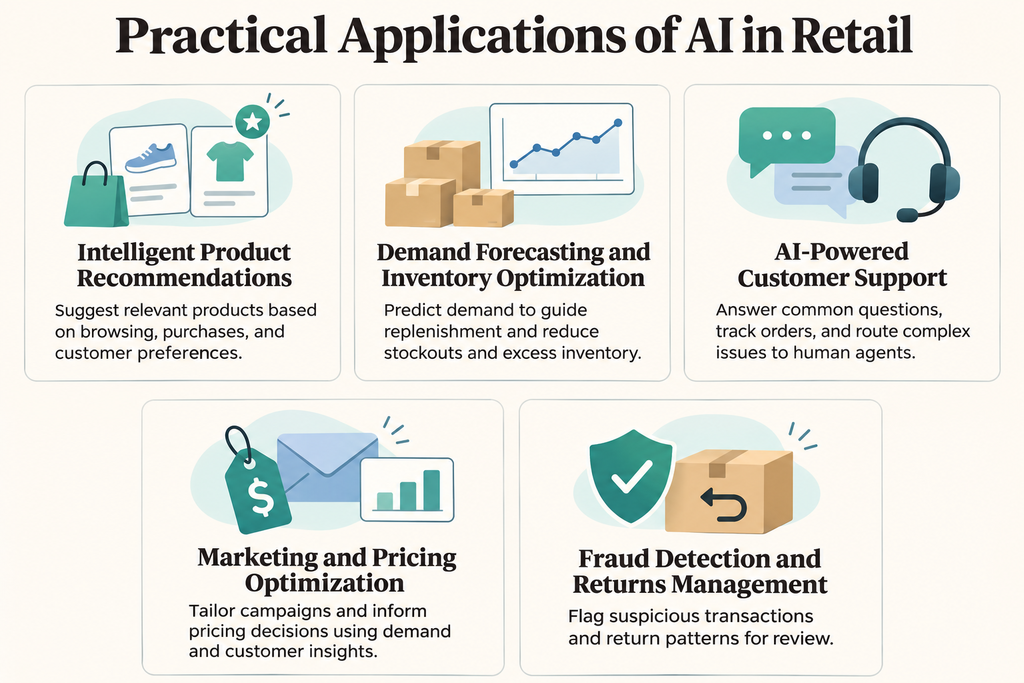
Intelligent Product Recommendations
Recommendation engines analyze how customers interact with the store and suggest products in line with the interests of each individual. By way of example, an online fashion retailer can offer clothing items that complement the previous purchases and the browsing activity of a shopper.
Demand Forecasting and Inventory Optimization
Machine learning models predict demand from sales records, seasonal swings, past promotions, and things outside the business, such as the weather or a holiday.
Once the forecast exists, it tells the retailer when to reorder and how to split stock between shops and warehouses. A business with a huge catalog, or with goods whose sales jump up and down from week to week, gets the most out of this.
AI-Powered Customer Support
Where is my parcel, can I return this, is the blue one in stock: AI chatbots and virtual assistants handle questions like these all day.
Provided that they are connected to verified business systems, the answers they give on a Sunday night are as reliable as those given on a Monday morning.
Marketing and Pricing Optimization
With the help of AI, marketing teams segment audiences, generate product descriptions, and evaluate how promotions have performed.
As for pricing, a model is able to take demand, the amount of stock, and the state of the market into account and propose a change in price. Still, the business itself has to lay down clear pricing rules beforehand and look through every proposal, since without this the outcome can easily become unfair or inconsistent.
Fraud Detection and Returns Management
Unusual patterns in transactions, which may be a sign of payment fraud or of someone misusing an account, are something AI systems notice quickly. Data about returns can be put through the same kind of analysis, and then the products that come back again and again for one and the same reason become visible.
How to Implement AI in Retail and eCommerce
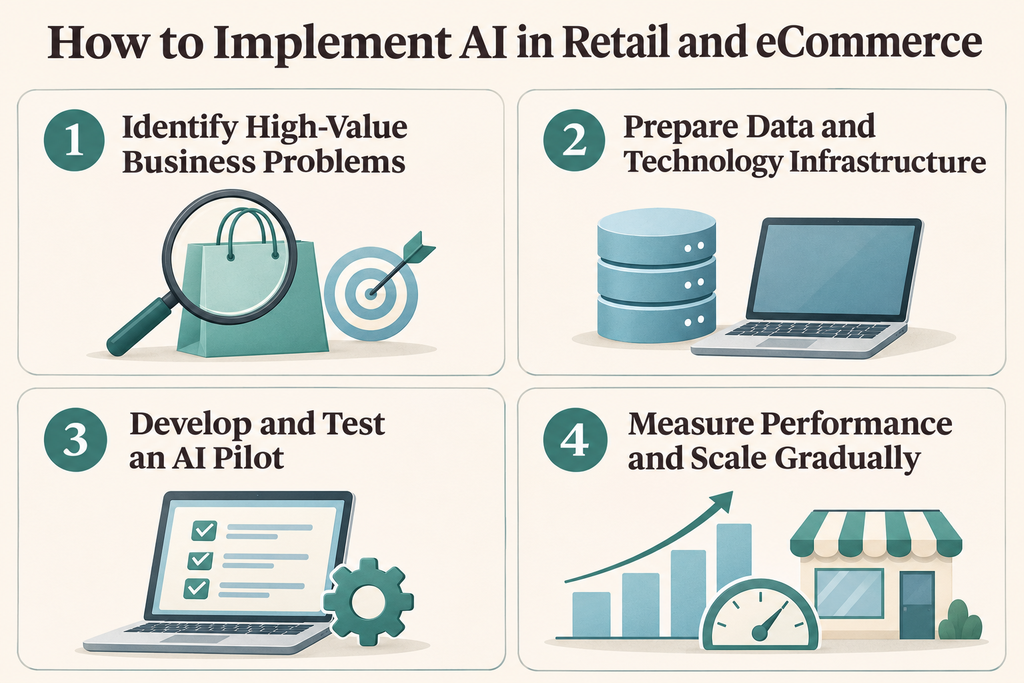
1. Identify High-Value Business Problems
It is reasonable to begin with the places where operations get stuck and where customers run into difficulties. Goods that sell out too often, shoppers who fail to find the product they came for, or a support team that cannot cope with the number of requests are typical examples.
Each of the possible applications deserves an evaluation of the effect on the business that can be expected from it, of how complicated it is to implement, and of the resources the company has at its disposal.
2. Prepare Data and Technology Infrastructure
The reliability of AI cannot exceed the reliability of the data it receives, and the data, in turn, has to be accurate, accessible, and well organized.
This is why a retailer is advised to review customer databases, inventory systems, product catalogs, and the eCommerce platform in use. Once all these sources are connected with each other, the outputs of AI models become considerably more useful.
3. Develop and Test an AI Pilot
Take an eCommerce business as an example. It could first try out an AI recommendation engine on a single product category, and only after that extend it to the whole store.
During the pilot, the results achieved with AI are compared with a suitable baseline. Only such a comparison tells whether the solution has brought real improvement or not.
4. Measure Performance and Scale Gradually
The choice of key performance indicators depends on what application has been selected. In one case it will be the conversion rate or average order value, in another the accuracy of forecasts, the time needed to resolve support requests, or inventory turnover.
A pilot that has proved successful may then be extended further, on the condition that people still oversee the system and the models continue to be evaluated.
Future Trends Shaping AI in Retail
Agentic commerce. Shopping agents are the newest arrival. A buyer gives the agent a task, and it goes off to research products, weigh the alternatives against each other, and help close the purchase.
Multimodal shopping experiences. Picture a customer who photographs a jacket on the street, uploads the picture, and types “same thing, but in green.” Systems that read images and text together make that kind of search possible.
Connected omnichannel experiences. Online and offline shopping may finally stop feeling like two separate stores. AI could link customer interactions, stock visibility, and personalized service, so the same customer is recognized whether he or she orders on a phone or walks into a branch.
Final Thoughts
A retailer who starts out with clearly formulated objectives, data that can be trusted, and pilot projects with measurable results will have less trouble scaling AI and adjusting to whatever shape digital commerce takes next.