
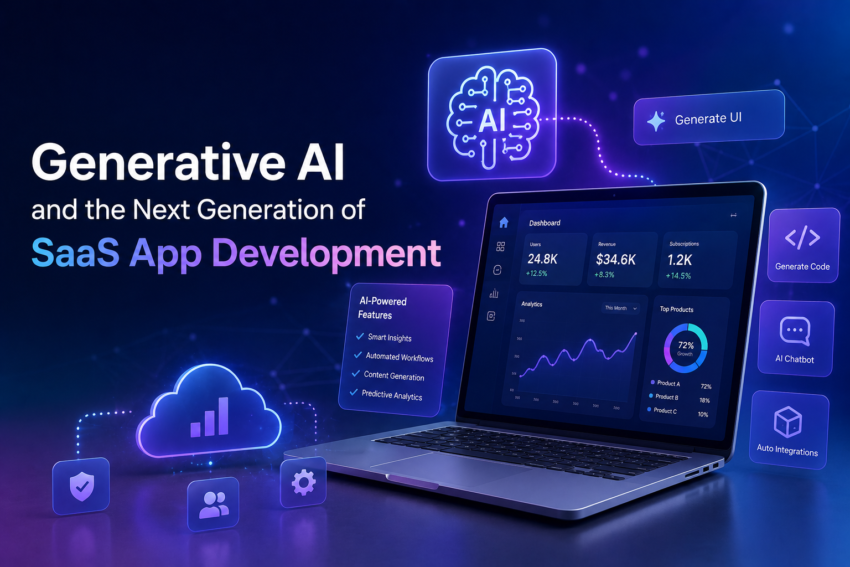
In the last decade or so, SaaS applications have been differentiated by a similar set of features: cleaner dashboards, quicker loading times, and an extra feature compared to their competitors. This strategy is getting stale fast. Consumers want software that understands the context of their needs, rather than just documenting them. A support system that only tracks tickets sounds dated next to one that composes responses.
This shift has a name: Generative AI SaaS Development. It describes the practice of building software-as-a-service products where generative AI models, rather than static rules and forms, sit at the center of the user experience. Instead of treating AI as a bolt-on chatbot widget, forward-looking product teams are designing applications around what large language models (LLMs) can actually do: understand context, generate content, reason through multi-step tasks, and act on a user’s behalf.
Companies are stepping outside the box of their current SaaS offerings because they have realized the cost of staying put. Competing products are being tested faster, reducing onboarding time and minimizing customer effort by providing native AI capabilities. In this article, we discuss what Generative AI SaaS Development is all about and how to build a product the right way.
What Is Generative AI SaaS Development?
Generative AI SaaS Development is the process of designing, building, and scaling cloud-based software products where generative AI capabilities, such as text generation, summarization, image creation, code generation, and conversational reasoning, are built into the core product experience rather than added as an afterthought.
What we refer to as traditional AI within SaaS would normally be a predictive model, i.e., a churn score, a lead-scoring algorithm, or a recommender system that has been built using previous clicks. The traditional forms of AI operate by predicting outcomes from patterns in previous data. However, generative AI works in a completely different manner. For example, it will write something, generate code, an email, or even a picture, while holding a conversation.
Three components typically define a generative AI-powered SaaS product:
- Large language models (LLMs): the reasoning and generation engine behind features like drafting, summarizing, and answering natural-language questions.
- AI agents: pieces of software that execute multi-step processes including the completion of forms, research, and even triage of help desk tickets, all without much human involvement.
- Automation and personalization layers: the logic that connects AI output to a user’s specific data, history, and preferences so the experience feels tailored rather than generic.
Taken together, these pieces enable a SaaS product to respond to what a user is actually trying to accomplish, rather than just presenting menus and fields for them to fill in manually.
How Generative AI Is Transforming SaaS Applications
The shift shows up across nearly every layer of a modern SaaS product.
- Intelligent automation. Repetitive, judgment-light tasks- categorizing support tickets, tagging leads, formatting reports- are increasingly handled without a human touch. AI automation in SaaS doesn’t just speed up these tasks; it removes them from a person’s queue entirely.
- AI-powered personalization. Instead of static user segments, generative AI can tailor onboarding flows, email copy, and in-app messaging to an individual account’s behavior in real time.
- Natural-language interfaces. Search bars and rigid filter menus are giving way to plain-language commands. A user can type “show me last quarter’s churned accounts in the Northeast” and get a direct answer.
- AI-generated content. The marketing platform will generate ad copy for you, while the HR platform generates job descriptions for you and the project management tool generates a summary of your meeting notes.
- Predictive insights, combined with generation. Older software could identify an anomaly; newer software can not only tell what it means but also suggest a next course of action.
- AI assistants and copilots. Many SaaS categories now ship an embedded assistant that answers product questions, drafts content, or walks a user through a workflow without a support ticket.
- Workflow automation. AI agents chain several actions together, pulling data from one system, formatting it, and pushing it into another, cutting down manual handoffs.
- Intelligent search and recommendations. Retrieval-augmented search understands intent and context rather than matching keywords, surfacing the right document even when a user’s phrasing doesn’t match the source text exactly.
Key Benefits of Generative AI for SaaS Products
The appeal of AI-powered SaaS applications shows up in measurable product and business outcomes.
| Benefit | What It Looks Like in Practice |
| Improved user experience | Fewer clicks, faster answers, less time spent hunting through menus |
| Increased productivity | Teams complete drafting, research, and reporting tasks in a fraction of the time |
| Greater automation | Routine workflows run with minimal manual oversight |
| Personalization at scale | Every account gets a tailored experience without added headcount |
| Reduced operational costs | Fewer support tickets and less manual data entry |
| Faster decision-making | Plain-language insights replace hours of manual analysis |
| Improved customer retention | Products that adapt to users’ needs are harder to replace |
| New SaaS revenue opportunities | AI-driven tiers and add-ons create fresh pricing and upsell path |
Taken together, these benefits explain why AI-driven SaaS solutions are moving from optional feature to core product strategy. Vendors that build strong AI integration for SaaS platforms are able to charge more, retain longer, and differentiate faster than competitors relying on feature parity alone.
Generative AI Use Cases in SaaS
Generative AI application development looks different depending on the underlying pattern; industry-specific use cases using AI to reduce manual work and surface better decisions hold steady across sectors.
| Industry | Example Use Case |
| CRM | Auto-generated call summaries, follow-up emails, and deal-risk alerts |
| Marketing automation | AI-drafted campaigns, subject-line testing, and audience segmentation |
| HR software | Job description generation, resume screening, and interview summaries |
| Project management | Meeting notes, task breakdowns, and status reports generated automatically |
| Customer support | AI chat agents that resolve routine tickets and draft responses for agents |
| Finance and accounting | Expense categorization, anomaly detection, and plain-language financial summaries |
| Healthcare software | Clinical documentation support and patient-intake summarization |
| E-commerce | Product description generation, personalized recommendations |
These are not hypothetical. Software providers across every category listed here are already shipping generative features, and the gap between AI-native products and legacy ones is becoming a real factor in buyer decisions.
How to Build a Generative AI-Powered SaaS Application
Building an intelligent SaaS application is a different discipline from bolting an API onto an existing product. A structured approach keeps the project grounded in business value.
- Identify the business problem. Do it by stating an actual pain point rather than a technology. “Support agents take too much time searching through documentation” is a problem worthy of solving using AI. “We should have AI somewhere” is not.
- Define AI use cases. Transform your pain point to a specific AI feature – it can be drafting, summarization or triaging assistant. Use cases are a way of keeping scope realistic.
- Select the appropriate AI or LLM model. Some use cases call for a general-purpose foundation model; others benefit from a smaller model refined through LLM Fine-Tuning Services that runs faster and cheaper at scale. This is a good stage to bring in Generative AI Solutions expertise if the internal team hasn’t built production LLM systems before.
- Design the SaaS architecture. Decide how AI services will fit into the existing stack: as a microservice, an embedded model, or a managed API call. Multi-tenant SaaS products also need to plan for how AI usage and data are isolated between customers.
- Integrate APIs and AI services. This is where generative AI integration services usually come in, connecting LLM providers, vector databases and orchestration tools to the rest of the application without disrupting existing workflows.
- Test AI capabilities. Assessment of output, prompts, and edge cases need to be done in practice. Generative outputs have to be tested on the basis of user inputs and not a few sample prompts.
- Implement security and data privacy. Customer data used in prompts or fine-tuning has to be handled under the same compliance standards as the rest of the SaaS platform, including encryption, access controls, and data retention policies.
- Application monitoring, optimization, and scaling. Once the application goes live, there needs to be monitoring for cost, precision, and latency of the AI features, as well as a process to train and update prompts depending on the usage patterns.
Those companies lacking internal expertise on AI usually collaborate with an AI development services provider for the stages of selection and implementation, while product design and road mapping decisions stay internal. For companies that consider their first AI feature, it makes sense to take a smaller step by developing an AI proof of concept development engagement before committing to a full build, which limits risk while still proving out the technical approach.
Challenges of Generative AI in SaaS Development
Generative AI brings real complexity along with its benefits, and ignoring these challenges tends to cost more later than addressing them early on.
| Challenge | Why It Matters |
| Data privacy | Customer data processing using prompts or pipelines requires governance and consent |
| Security | AI creates new vectors for attacks, including prompt injection and data leakage |
| Hallucinations and accuracy | Generated content can be confidently wrong, which is especially risky in regulated industries |
| AI infrastructure costs | Inference and fine-tuning costs can scale unpredictably with usage |
| Model selection | Picking the wrong model for the task wastes budget and underdelivers on quality |
| Scalability | AI features need to perform under real production load, not just demo conditions |
| Integration complexity | Merging LLMs with the current database and permission structures requires engineering expertise |
| Compliance and governance | Industries like finance and healthcare require documented, auditable AI decision processes |
Any of these challenges are not the reasons to avoid Generative AI SaaS Development. They’re reasons to plan for them from the start, with the right architecture, the right partner, and realistic expectations about what a first release should include.
The Future of Generative AI and SaaS
The next phase of AI-driven SaaS products is already taking shape, and a few trends stand out.
- AI agents in SaaS. Products are moving from answering questions to completing tasks: booking, filing, updating records, and following up, often without a person clicking through each step.
- Autonomous workflows. Multi-step processes that once required several tools and manual handoffs are increasingly handled end-to-end by chained AI actions.
- Multimodal SaaS applications. Text, image, voice, and video are converging into single interfaces, letting users interact with software however is most natural for the task at hand.
- AI copilots. Rather than a separate chatbot, copilots are becoming embedded across the entire product, present wherever a user might need help.
- Personalized user experiences. Interfaces increasingly adjust their own layout and content based on how each user actually works.
- AI-native SaaS products. New entrants are being built with AI as the foundation of the product rather than a feature added after launch, which gives them a structural advantage over retrofitted competitors.
- Smaller and specialized AI models. Several development teams are moving away from developing large general-purpose AI models to smaller task-oriented AI models, which are cheaper to maintain and easier to control.
How Businesses Can Prepare for AI-Powered SaaS
Companies weighing generative AI adoption don’t need to have every answer before they start, but a few steps make the transition smoother:
- Audit workflows for AI fit. Look for tasks that are repetitive, language-heavy, or time-consuming, since these tend to benefit most from generative AI features.
- Start with a focused use case. A single, well-scoped feature proves value faster than a sprawling AI initiative and gives the team real usage data to learn from.
- Involve security and compliance early. Data handling decisions are far cheaper to make before a feature ships than after.
- Choose the right technical partner. Whether that’s an internal team, an AI consulting services engagement, or dedicated support through hire AI developers, the goal is matching expertise to the complexity of the use case.
- Consider iteration. As with any feature, the performance of generative AI improves with actual usage and feedback; therefore, allocate time and effort to the process after launch, not only before it.
- Think about AI as product strategy. Companies that integrate AI into their product strategy, not as a side initiative, experience greater uptake and retention.
Conclusion
Generative AI SaaS Development is no longer a trial by rich startups only. Rather, it has become a bare-minimum standard across CRM, Marketing, HR, Finance, Healthcare, and E-commerce software development, and companies that have made AI an integral part of their products are leading the race within their domains.
The journey ahead does not entail reinventing the whole wheel in a day’s time. The process begins with the identification of the actual problem, the selection of the appropriate model and architecture, and the construction process that considers security and scalability from day one. Organizations that get their basics right, whether done so internally or with external organizations that offer Custom Software Development and SaaS Development Services, will be ahead of the curve.